-
About
About the Company
About
About the CompanyBusiness Process Outsourcing
July 6, 2026

Global business has entered a new era where stability can’t be easily assumed or even used as a definite statement. For companies across Europe, the Middle East, Africa (EMEA), and Australia, traditional operating models that once delivered efficiency and predictable growth are being re-evaluated. Geopolitical uncertainty, labor shortages, digital disruption, rising operational costs, and increasingly demanding customers have fundamentally changed how organizations compete.
It’s no longer a question of whether a company should expand internationally or adopt digital technologies. Instead, business leaders should be focusing on whether their current operating model is still capable of supporting sustainable growth in an increasingly unpredictable world. That’s because the answer is often “no.”
For many years, organizations designed their operations around centralization. Headquarters made strategic decisions, regional offices executed them, and support functions were often concentrated in one or two locations. This approach worked well when markets were relatively stable, and business environments changed gradually. However, it is vastly different now.
A supply chain disruption in one region can affect customer service halfway around the world. New regulations can emerge with little warning. Artificial intelligence is transforming workflows faster than many organizations can redesign their internal processes. At the same time, customers expect fast, localized, multilingual, and personalized experiences regardless of where they are located.
As a result, companies are shifting from rigid organizational structures toward operating models that prioritize flexibility, resilience, and global collaboration.
Although businesses worldwide are adapting, organizations across EMEA and Australia face several unique pressures that make operating model transformation particularly urgent.
Many developed economies are experiencing persistent shortages of skilled professionals, particularly in customer support, technology, finance, and business operations.
Hiring locally is becoming increasingly expensive, while retaining experienced employees has become equally challenging. Organizations are realizing that relying solely on domestic talent limits both scalability and competitiveness.
Nowadays, businesses don’t just think about where they can “hire.” They change their mindset to thinking about where they can “build the strongest global workforce.”
This shift encourages businesses to embrace distributed teams, offshore specialists, and outsourced operational support while maintaining consistent quality standards.
Cloud platforms, automation, artificial intelligence, and data analytics have dramatically improved operational capabilities. Ironically, these same technologies have also exposed inefficiencies.
Many companies have invested heavily in digital tools while continuing to operate under legacy organizational structures. Digital transformation alone cannot solve fragmented workflows, duplicated responsibilities, or poor communication across regions.
Technology delivers value only when the operating model is designed to maximize it. Organizations are therefore redesigning processes, redefining responsibilities, and creating more integrated global teams capable of leveraging digital investments effectively.
Global expansion has increased customer expectations rather than simplifying operations. Clients expect support in their preferred language. They expect culturally appropriate communication. They expect quick responses regardless of time zone. They expect consistency across every interaction.
Meeting these expectations requires far more than translation software or automated chatbots. It requires people who understand both the language and the cultural context behind customer communication.
For many EMEA and Australian organizations, this reality has accelerated investment in multilingual support teams and globally distributed customer service operations.
Recent years have demonstrated how quickly business conditions can change. Economic uncertainty, cyber threats, geopolitical tensions, supply chain interruptions, and evolving regulatory requirements have made resilience a board-level priority.
Businesses are no longer optimizing operations solely for cost efficiency. They are optimizing for continuity.
Diversifying operational capabilities across multiple countries reduces dependency on a single labor market, office location, or business function. Companies with geographically distributed operations are often better positioned to maintain service levels during unexpected disruptions.
The modern operating model is designed not only to perform during periods of stability but also to adapt during periods of uncertainty.
The perception of outsourcing has changed significantly.
Historically, outsourcing was often viewed primarily as a cost-reduction initiative. Now, forward-thinking organizations increasingly see outsourcing as a way to access specialized expertise, accelerate transformation, improve operational agility, and strengthen business resilience. Rather than outsourcing entire departments indiscriminately, many companies selectively partner with providers that complement their internal capabilities. This allows leadership teams to concentrate on innovation, customer strategy, and business development while trusted partners manage operational functions such as multilingual customer support, back-office processing, digital operations, technical assistance, and business process management. The result is a more flexible organization capable of responding quickly to changing market conditions without continually expanding internal headcount.
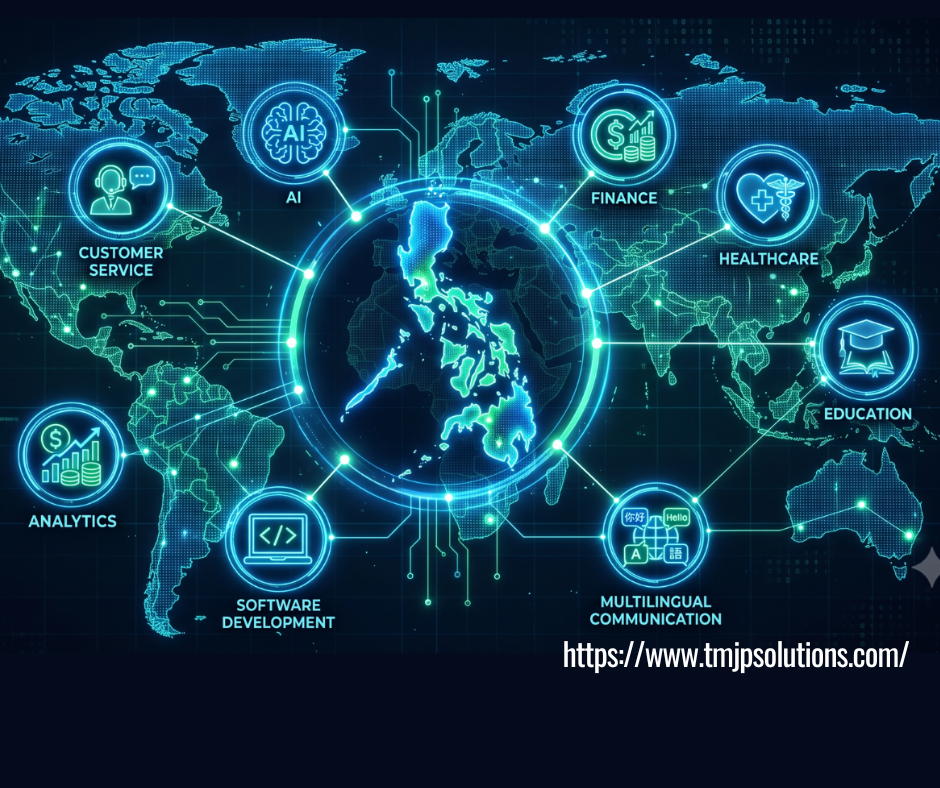
As businesses redesign their global operating models, the Philippines continues to strengthen its position as one of the world’s leading destinations for business process outsourcing and shared services.
Beyond its established reputation for customer service, the country offers a combination of highly educated professionals, strong English proficiency, cultural adaptability, and growing expertise in digital operations, finance, IT support, multilingual services, and knowledge-based work.
For companies serving diverse international markets, including those across EMEA and Australia, the Philippines provides more than operational capacity. It offers access to globally minded professionals who can integrate into international teams, support multilingual customer engagement, and contribute to continuous process improvement.
Organizations seeking both operational efficiency and long-term resilience increasingly view the Philippines as a strategic extension of their global operations rather than simply an offshore delivery location.
Redesigning a global operating model is not simply about relocating work, reducing costs, or adopting the latest technologies. Those are tactical decisions.
The real strategic challenge is creating an organization that remains competitive regardless of how markets evolve.
Business leaders who continue to optimize for yesterday’s conditions risk building organizations that are efficient but inflexible. In contrast, those who design operating models around resilience, talent accessibility, digital integration, and customer-centricity position their companies to adapt more effectively to future disruptions.
Ultimately, competitive advantage no longer belongs solely to businesses with the largest budgets or the most advanced technology. It belongs to those with operating models capable of learning, adapting, and scaling across borders.
In a world defined by constant change, the operating model itself has become one of an organization’s most valuable strategic assets.